
Pad Thai Origins: Its Ingredients and National Story

Pad Thai’s story is about more than a plate of stir-fried noodles: it reflects Chinese culinary influence and Thailand’s effort to shape a shared national identity. The history of Pad Thai traces a rice-noodle dish, adapted to Thai tastes, to the nation-building campaign of the 1930s and 1940s.
Pad Thai is known for its lively balance of sweet, sour, salty and savoury flavours. Tamarind, fish sauce and sugar season the sauce, while lime and crushed roasted peanuts are often served at the table. The chilli level can vary.
This guide explains what defines Pad Thai, how its noodles, proteins and garnishes vary, and how Chinese influences and a government campaign shaped its national story. From the dish’s noodle traditions to its place in Thai food culture, its familiar flavours reflect a history of adaptation.
Table of Contents
Pad Thai’s ingredients and defining characteristics
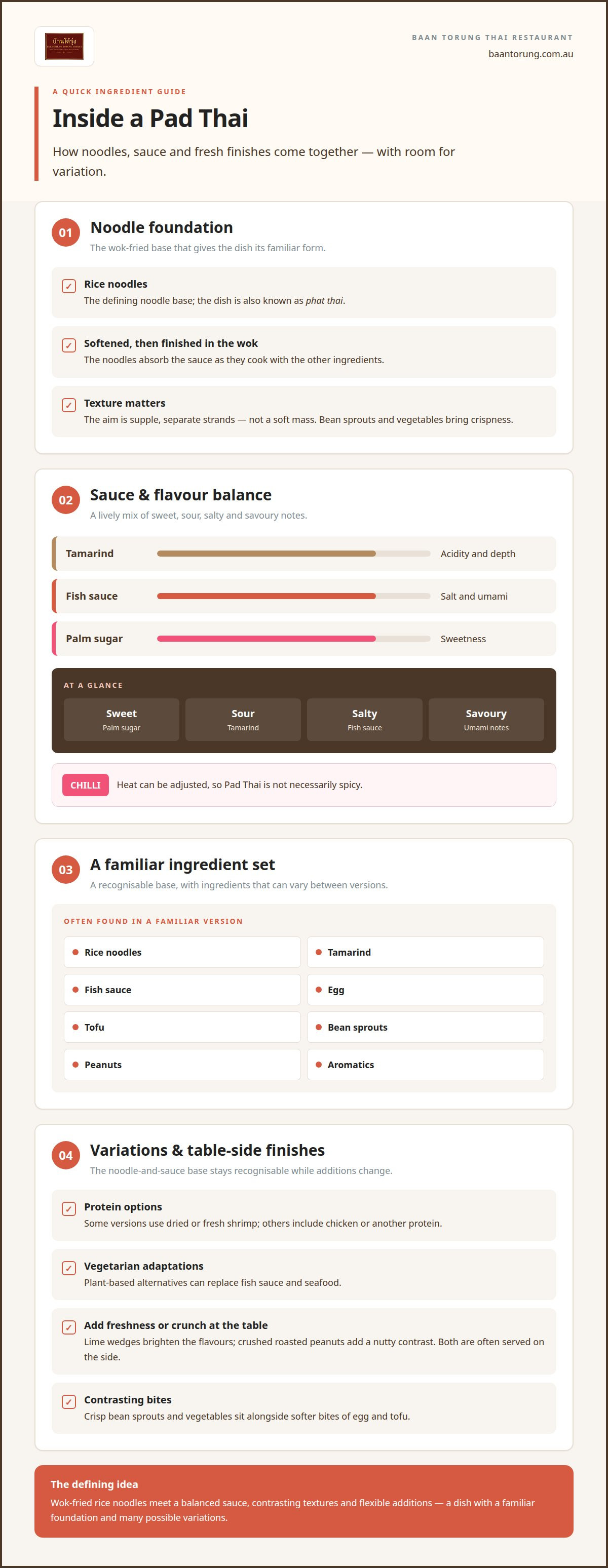
Pad Thai, also written as phat thai, is a stir-fried rice noodle dish. Cooks typically fry its ingredients in a wok, bringing noodles, sauce and other elements together. A familiar version combines rice noodles, tamarind, fish sauce, egg, tofu, bean sprouts, peanuts and aromatics. The result balances savoury seasoning with bright, fresh and gently sweet notes.
Early Pad Thai recipes combined rice noodles with ingredients such as tamarind, fish sauce, egg, tofu, bean sprouts, peanuts and aromatics. Some versions use dried or fresh shrimp; others include chicken or another protein. The variations preserve the recognisable noodle-and-sauce base while changing the ingredients around it.
In Thailand, tamarind, palm sugar and fish sauce are traditional sauce ingredients. Tamarind adds acidity and depth, fish sauce brings salt and umami, and palm sugar contributes sweetness. Chilli provides adjustable heat, so Pad Thai is not necessarily spicy. Lime brightens the flavours at the table, while crushed roasted peanuts add a nutty contrast.
Texture is as important as flavour. Rice noodles are softened before cooking and finished in the wok, where they absorb the sauce. The goal is supple, separate strands rather than a soft mass. Bean sprouts and vegetables add crispness, while egg and tofu offer softer bites alongside the noodles.
Recipes also change to suit different tastes and diets. Vegetarian versions can use plant-based alternatives to fish sauce and seafood, and protein options can range from shrimp to chicken. Lime wedges and crushed roasted peanuts are often served on the side, so diners can add freshness or crunch to their plate.
Pad Thai spread internationally through migration, restaurant growth and deliberate promotion of Thai cuisine. In 2001, Thailand established the Global Thai Restaurant Company to help establish at least 3,000 Thai restaurants worldwide. The number of Thai restaurants outside Thailand grew from 5,500 to more than 15,000 over the following seventeen years, helping familiarise diners with Thai dishes.
Plaek Phibunsongkhram’s nation-building campaign
Plaek Phibunsongkhram, known as Phibun, promoted national unity through cultural change. His government’s campaign helped Pad Thai gain prominence in Thailand during the 1930s and 1940s.
Government promotion and national identity
Phibun’s government encouraged people to see shared customs as part of a stronger national identity. From 1939-1942, Phibun passed 12 Cultural Mandates promoting productivity, good manners and pride in Siam. The campaign also promoted national identity, economic strength and improvements to the country’s diet. For readers, this context explains why a noodle dish became connected with national life, rather than remaining simply one meal among many.
The emergence of a national dish
Phibun’s government promoted Pad Thai as part of its wider nation-building effort. The dish gained national prominence during the 1930s and 1940s, as officials linked noodles with modernisation and cultural identity. This helps explain its national status: the story involves government promotion as well as cooking traditions. Historian Mark Padoongpatt describes Pad Thai as created in Thailand in the 1930s as part of nation-building.
Political change had already reshaped Siam. In 1932, the People’s Party overthrew the absolute monarchy in a coup d’état. Phibun became prime minister in 1938, then led the country through a period of deliberate cultural change. His government changed the country’s name from Siam to Thailand during this nation-building campaign, reinforcing the effort to define a shared national identity.
Pad Thai’s rise was part of a broader government programme, not the result of a single decree declaring it the national dish. Promotion presented it as a practical, recognisably Thai meal during a period focused on modernisation and national pride. Its national significance grew through continued promotion and everyday cooking, bringing together political ambition, changing cultural expectations and a dish that became familiar across Thailand.
The dish’s Chinese and possible Vietnamese origins
Pad Thai blends Chinese noodle traditions with Thai culinary adaptation. Its rice noodles and stir-fried preparation reflect exchanges shaped by migration, trade and local tastes. Some accounts also suggest a possible Vietnamese connection, but Chinese influence, particularly Teochew, is the clearest named strand in the dish’s history. Recognising these influences helps explain its multiple cultural reference points.
The Thai term kuai tiao comes from the Teochew word guê2 diao5, referring to a type of thick Chinese rice noodle. That linguistic connection offers a specific clue to the dish’s noodle heritage. Some people believe Chinese traders brought a similar dish to Siam in the 1700s, although that account describes a possible precursor, not necessarily today’s Pad Thai.
Migration provides broader context. Chinese communities had been moving to Thailand since the 12th century, and by the early 1900s, about one-seventh of Thailand’s population was of Chinese descent. Teochew migrants formed part of this long connection. Their influence helps explain how Chinese-style noodles became familiar within Thai food culture, ready to be adapted rather than simply copied.
Before Pad Thai became popular, many Thai people ate rice with chilli paste, leaves and salt. Chinese food vendors also sold lunches and snacks, bringing noodle dishes into everyday meals. These examples show how ingredients and cooking ideas travelled through daily food culture. Thai cooks adapted them to local tastes, helping the dish develop its own identity.
A Vietnamese connection remains a possible part of the story, but it is not the sole explanation for Pad Thai’s origins. The specific language clue points to Teochew, while the broader account describes Chinese migration meeting Thai cooking. For anyone tracing the dish’s roots, it helps to distinguish influence, adaptation and origin: they are related, but not interchangeable. Pad Thai emerged through cultural exchange, not a single source or simple route.
Traditional noodle varieties and garnishes
Pad Thai noodles connect practical cooking with Thailand’s wartime food history. During World War II, pressure on rice supplies made noodles a useful way to stretch and transform rice. Flooding and war damaged supply, while promoting noodles aimed to reduce domestic rice consumption and leave more rice available for export. In 1942, flooding damaged paddies in the Chao Phraya River Delta, including Bangkok, for three months.
Rice noodles also offered a different way to use rice. The rice used for noodles was described as 50% of the amount consumed when rice was eaten unprocessed. That relationship helped make noodle dishes part of efforts to manage rice use. During the 1940s, authorities encouraged Pad Thai vendors to sell from wheeled noodle carts, fitted with a heat source and compartments for ingredients and utensils.
Noodle choice shapes the final texture. Cooks may use sen lek or the chewier sen chan, associated with Thailand’s Chantaburi region. Rice noodles are soaked until flexible but still structured, then finished in the wok as they absorb the sauce. Tossing them with the other ingredients helps keep the strands supple and distinct rather than soft and clumped.
Professional cooks may also make Pad Thai on a flat-top griddle, which suits efficient service. Whatever the cooking surface, timing matters: the noodles must absorb the sauce without losing their shape. Lime wedges and crushed roasted peanuts are commonly served alongside, adding brightness and crunch. A banana leaf may be used as a traditional plate or liner, adding a visual detail to the meal.
These choices reveal how noodle type, cooking method and presentation shape each serving. If you’d like to explore Thai cooking techniques in practice, join a Thai cooking class and learn more about the craft behind familiar dishes.
Baan Torung Thai Restaurant
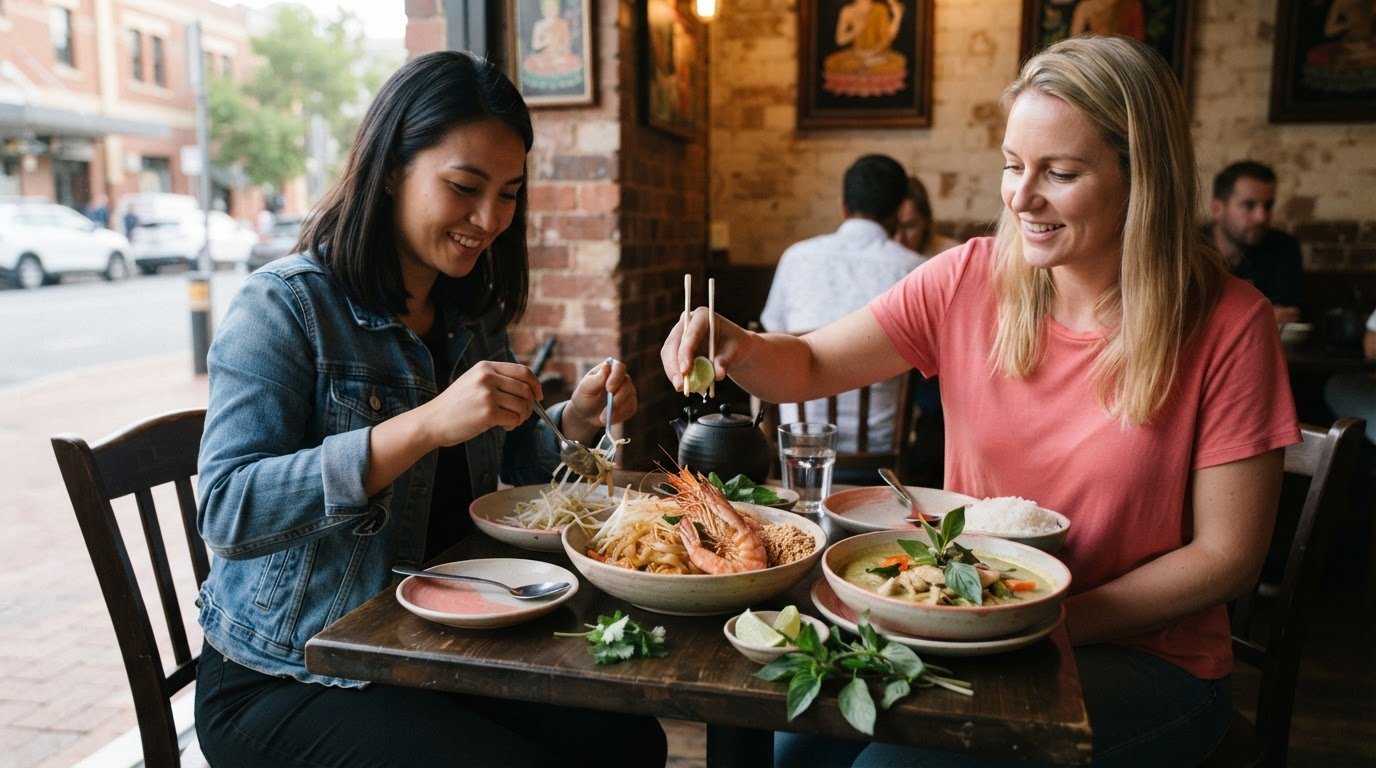
In Perth, Baan Torung brings the story of Pad Thai to the table with its Torung Pad Thai with Shark Bay Prawns. Tom Yum Goong, Torung Home Cooked Green Curry and Red Duck Curry offer other ways to explore Thai cooking, prepared with fresh ingredients and herbs.
Enjoying Thai cooking at Baan Torung is a way to connect the dish with the ingredients, influences and national story explored here. The kitchen focuses on fresh ingredients, Thai herbs and homely, delicate cooking styles.
For a taste of Thai cooking in Perth, visit Baan Torung and try its Torung Pad Thai with Shark Bay Prawns.
Let the story lead to your next meal
The history of Pad Thai can make a familiar meal feel newly layered. As you enjoy Thai food, notice how each cook’s choices shape the experience, from flavour balance to the ingredients on the plate. Food traditions live on in everyday meals, shared around tables and carried into new kitchens.
At Baan Torung in Perth, explore that living food culture with Torung Pad Thai with Shark Bay Prawns, Tom Yum Goong or Torung Home Cooked Green Curry. Each dish offers a different way to enjoy the care and character of Thai cooking.
If you’d like to plan a visit or ask about dining, you’re warmly invited to contact Baan Torung Thai Restaurant. We hope your next Thai meal brings a little more curiosity, enjoyment and connection to the story behind it.
Frequently Asked Questions
What is Pad Thai?
Pad Thai is a Thai dish of rice noodles stir-fried with sauce and other ingredients. A serving may include egg, tofu, vegetables and a protein, with garnishes on the side. The name is also written as phat thai. Rather than a fixed recipe, Pad Thai is a flexible dish: cooks and diners can vary the ingredients and chilli heat.
What are the origins of Pad Thai?
The history of Pad Thai reflects cultural exchange and Thai adaptation. The Thai term kuai tiao comes from Teochew, and a similar dish may have reached Siam with Chinese traders. Thai cooks reshaped noodle traditions to suit local tastes, giving the dish its own identity. Possible Vietnamese connections are sometimes discussed, but the clearest influences in this account are Chinese and Thai.
When did Pad Thai become popular in Thailand?
Pad Thai gained national prominence in Thailand during the 1930s and 1940s, when Plaek Phibunsongkhram’s government promoted noodles as part of a modern national identity. Its growing prominence wasn’t simply a matter of changing tastes: government messaging gave the dish a public role. Later, everyday cooking helped it become an established part of Thai food culture.
How has Pad Thai changed over time?
Pad Thai has changed through adaptation rather than following one unchanging recipe. A cook might use prawns or chicken, while a vegetarian version can substitute plant-based alternatives for fish sauce and seafood. Noodle choice and garnishes also affect the texture and finish. As the dish spread internationally, cooks adapted it for different diners while keeping stir-fried rice noodles at its centre.
How does traditional Pad Thai differ across regions of Thailand?
There is no single ingredient combination that defines every regional serving. Noodle choices include sen lek and the chewier sen chan, associated with the Chantaburi region. Protein and garnishes can vary as well. These differences are choices within a shared dish, not evidence of one regional recipe that applies throughout Thailand.
What role did wartime rice shortages play in Pad Thai’s history?
During World War II, pressure on rice supplies made noodles a practical way to stretch and transform rice. Flooding also damaged paddies in the Chao Phraya River Delta, including Bangkok, for three months in 1942. Promoting noodle dishes aimed to reduce domestic rice consumption, leaving more rice available for export. This wartime context is one part of the history of Pad Thai and its place in public life.
Comments